Language shapes the way we understand and describe the world. When discussing neurodiversity, the words we use to describe ourselves and others impact our identity, sense of belonging, and understanding of difference. They also reveal the assumptions and beliefs we have about these differences in ourselves and others.
Why does this matter?
For most of modern history, society has viewed human differences through what has become referred to as the pathology paradigm (or the medical model). This approach assumes there is one “normal” or “healthy” way for brains and bodies to function, and that any variation is a disorder or a deficit that needs fixing. In the past, this led to people deemed different being hidden away; many still feel the need to hide their true selves. This perspective has also contributed to potentially harmful interventions such as Applied Behaviour Analysis (ABA) and continues to drive gene programmes looking to ‘cure’ neurodivergent people.
When we continue with language rooted in the pathology paradigm, words like‘normal’, ‘disorder’, ‘high-functioning’, ‘condition’ and even ‘neurotypical’, unintentionally reinforce the idea that there is a correct way to be, and an incorrect way. This has significant implications for the individual perceived as different, both on a personal level and at a systemic level.
The neurodiversity paradigm, on the other hand, recognises there is natural variation across the human species; we are different, and this is not only ok but also normal. It opens the door to reasonable adjustments and suggests options for more inclusive environments, interactions, and systems.
The words themselves
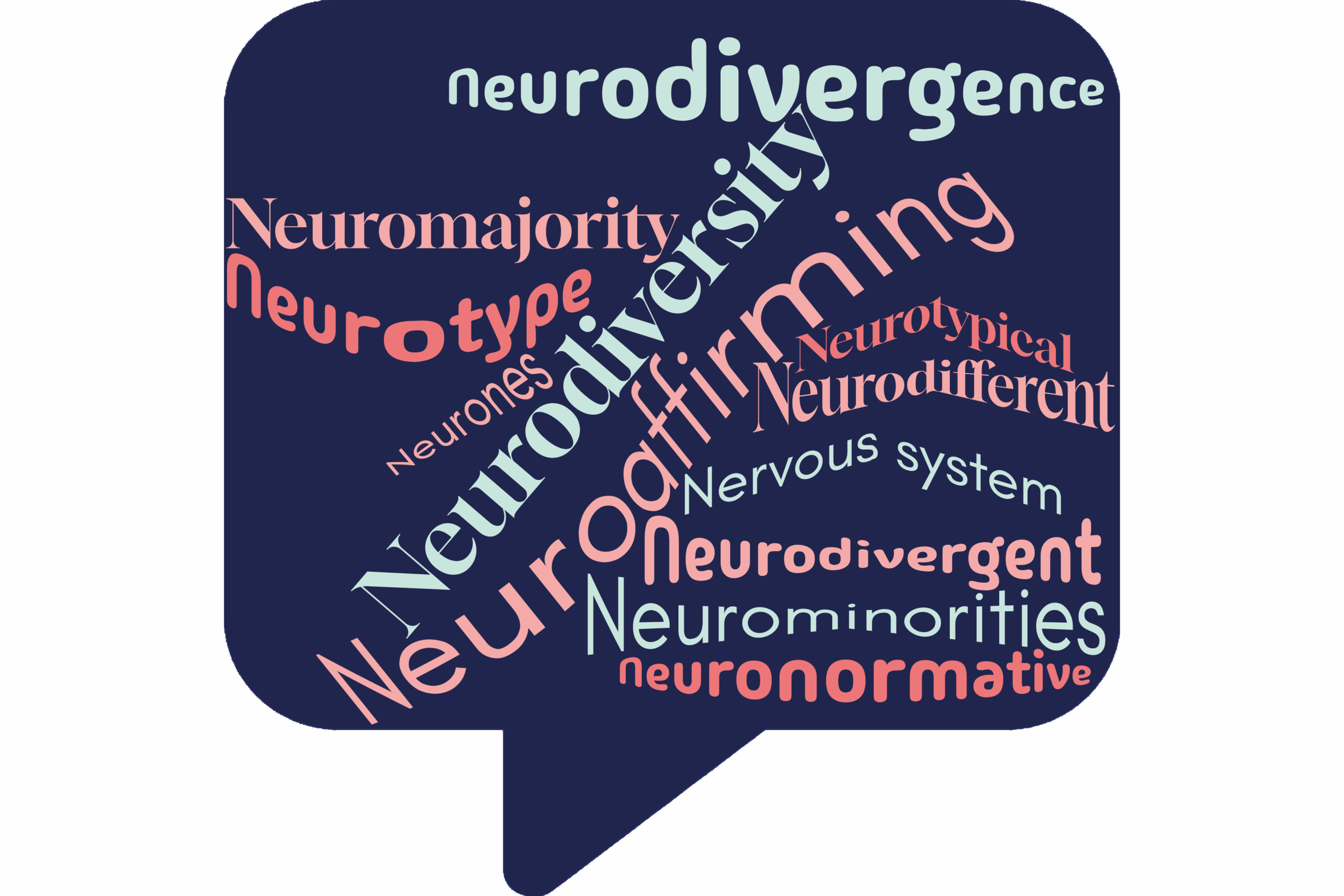
An individual can be neurodivergent (or neurodifferent). In other words,the person’s neurology diverges from what society has traditionally expected – they have a cognitive experience which diverges from neuronormative expectations, and, from a sensory perspective, they experience aspects of the world differently. These differences may be genetic or acquired through trauma, injury, illness or the use of psychadelics.
But an individual cannot be neurodiverse. ‘Neurodiverse’ describes a group, not a person. So, neurodivergence refers to the broader pattern of difference. A population or community can be neurodiverse, because it includes people with a range of neurotypes.
But when we’re talking about groups of people who all share some form of neurological divergence, it’s more accurate to describe them as neuro-minorities.
These distinctions matter, not least because they help us discuss individuals and the wider population without judgment, but also because they shift the focus, intent and tone of research and of the support offered to neurodivergent people.
Beyond the brain: a full-body experience
A common misconception is that the ‘neuro’ in neurodivergence refers solely to the brain. In fact, it relates to all our neurones. Neurodivergent differences are expressed in more than brain wiring. Neurones carry information throughout our body, and are involved in sensory processing, motor control, physical and emotional regulation, indeed all the autonomic functions of the body.
Focusing solely on the brain misses the broader picture. Our neurology shapes how we experience life at every level. The nervous system is the interface between oneself and the environment; it is not just a set of neural circuits in the head. Understanding this helps us move away from the idea that neurodivergent conditions are ‘brain disorders’ and towards recognising them as a whole-body way of being. This, in part, helps to explain why many neurodivergent people are unimpressed with the idea of searching for a cure for autism, knowing their autism shapes their whole person, and that it is not possible to separate them from their autism.
Rethinking ‘neurotypical’
The word “neurotypical” can cause problems. And when I wrote the first edition of my book, I too, unconsciously conformed to the pathology paradigm, using this binary approach to our species, inadvertently suggesting there was a right way and therefore a wrong way to be.
Instead, it’s more accurate to talk about neurotypical behaviours rather than neurotypical people. This way, we refer to the behaviours and thought patterns that a particular culture sees as ‘acceptable’ or ‘normal’. It does not exclude neurodivergent people from sharing many of these behaviours in some form. And in fact, the reverse is also true. Some behaviours considered autistic are found throughout the human population, but in a variety of forms – stimming is an example of this.
What is a viable alternative? It has been suggested that the terms neuromajority and neurominority be used to reflect the discrepancy in the size of these populations, while not implying that one is ‘normal’, and therefore the other is not.
Seeing neurotypical in this way, as a description of behaviour – a social construct rather than a unified brain type, helps us step away from the idea of ‘us and them’. Instead, its use is simply to observe that cultures define neuronormative ways of being, which are suited to the environments we have built over time, and that this does not always suit neurodivergent ways of thinking and being.
The Neurodiversity Movement
It’s also useful to separate neurodiversity as a concept from the Neurodiversity movement as a social movement. The Neurodiversity movement is not a single organisation, and it doesn’t have a leader. It’s a broad, global civil rights movement driven by many voices, campaigns and communities.
It aims to change how the world talks about neurodiversity and how society treats neuro-minorities. It believes in shifting the narrative from ‘what’s wrong’ to ‘what’s different’ and challenging systems built around narrow definitions.
In this sense, the Neurodiversity movement sits alongside other social justice movements – feminist, queer, disability and anti-racist activism – all pushing for recognition, equality and cultural change.
Crucially, it is not about erasing differences or ignoring the challenges faced by neurominorities, but about noticing them, supporting them and embracing the strengths which come from these differences.
Internalised narratives
Even as we start to embrace the Neurodiversity paradigm, it is unfortunate but understandable that most of us still carry traces of the pathology paradigm. Growing up in a world that measures people against ‘normal’, we naturally absorb those concepts. We unconsciously adopt the language, expectations and self-criticism of the dominant culture, even when we consciously reject its ideas.
This is sometimes called internalised ableism – when society’s judgements about difference become our own inner voice. It can show up as thoughts like:
“I should be able to do this”
“I’m being too sensitive”
“I need to hide this part of myself”
Recognising these thoughts is the first step to loosening the hold of the pathology paradigm. When we become aware of these inherited narratives and beliefs, we can begin replacing them with language and ideas that are more aligned with the neurodiversity paradigm.
Is masking a form of internalised ableism?
This is a question I often ask myself as I think about my own internal narratives. I have been a heavy masker throughout my life, and a common instruction given after diagnosis is ‘drop the mask’.
In the context of this article, the cognitive dissonance for me is as follows: if I choose to continue masking, consciously adapting my behaviour to meet societal norms, am I perpetuating the pathology paradigm, or am I simply navigating the reality of the world as it currently is?
The answer isn’t simple.
Masking is a survival response to living in a society that isn’t yet fully inclusive. For many, it’s a practical way to stay safe, keep a job and manage social interactions. Seen that way, it’s a realistic response to the world as it is now. Change is slow, and for neurominorities used to prejudice, judgment, micro and overt aggressions, expecting us to simply ‘drop the mask’ is unrealistic. Does this mean we are still operating from within the pathology paradigm? Perhaps. Is this ok? No. Is there a clear alternative? Not really.
For now, the only way I have been able to resolve this in my own mind is through conscious choice and awareness. I will mask on my own terms, as and when I feel I need it to cope or stay safe. I look for opportunities to unmask, and I know who my safe people are. It remains a useful survival mechanism, but it is no longer my default starting point. If you are interested in investigating the opportunities around dropping the mask, (or not) why not book a discovery call to talk about how we might do this together.
So, again why does all this matter?
Language isn’t just about communication; it’s about culture. The words we choose shape the stories we tell about ourselves and each other.
When we use language grounded in the neurodiversity paradigm, we help shift society towards greater understanding and acceptance. It’s not just a matter of semantics – it’s about recognising the value of all kinds of minds and bodies.
Getting this right doesn’t just change how we talk; it changes how we see one another. And that’s where real inclusion begins.
How does this shape my coaching practice?
My approach is now firmly grounded in the neurodiversity paradigm, which means I work with you to explore how your unique neurology shows up in daily life, how it influences your energy levels, your relationships, work patterns, and self-perception. By reframing our conversation away from ‘fixing’, we can instead uncover strategies that are affirming, sustainable, and authentic, and investigate constructive perspectives to move forward.
Coaching in this sense is about creating space for genuine self-recognition and for developing ways of living and working that align with who you are.
If this perspective resonates with you, whether you identify as neurodivergent or simply want to understand these ideas more deeply, I invite you to explore with me how a neuro-affirming coaching approach might support your next steps.